
Concrete driveway building in Austin MN - a slab built for Minnesota winters
Cracked, sinking or puddling driveway? We dig out, pack a solid base and pour a new slab that drains away from your house.
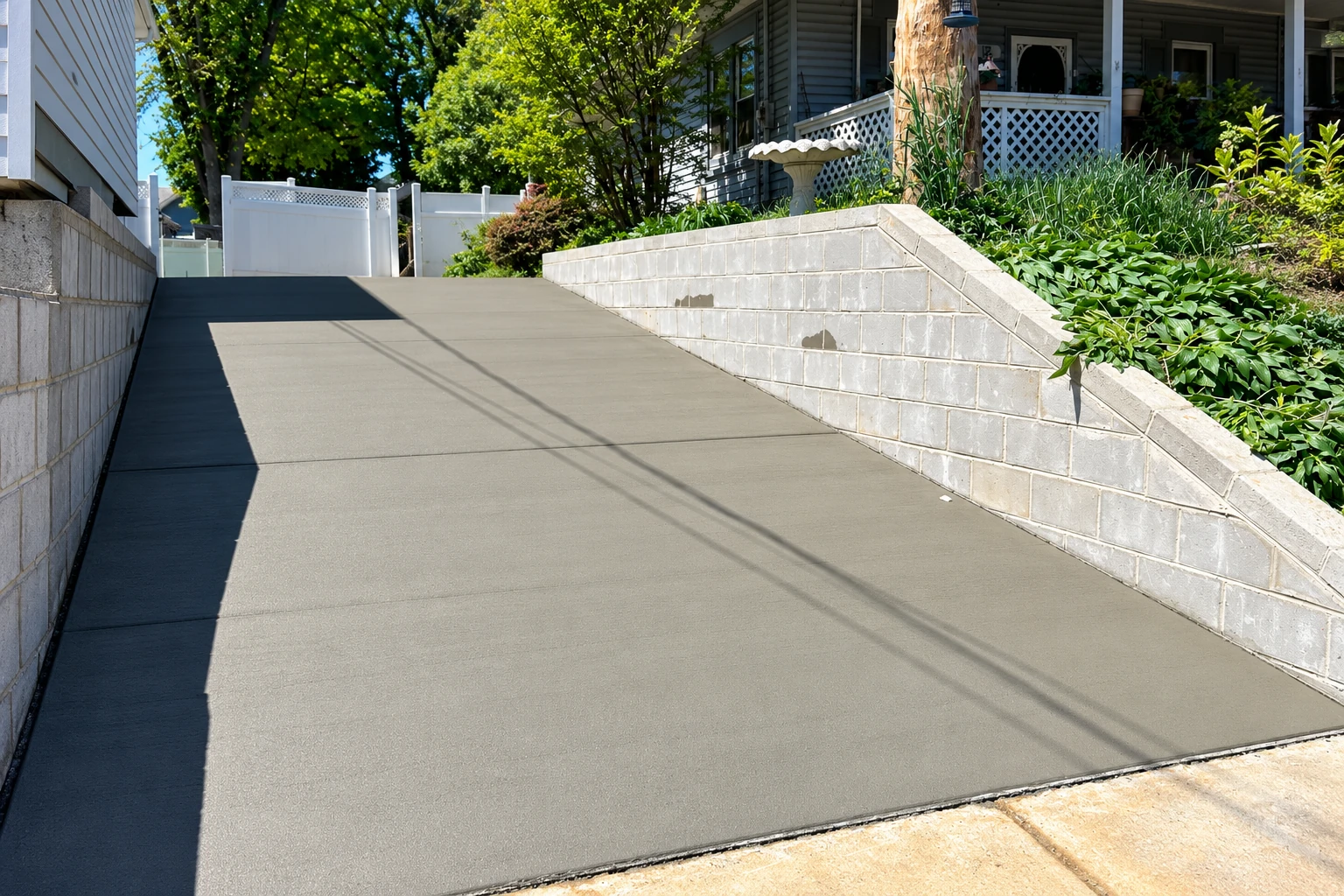
What goes into building a concrete driveway in Austin?
Concrete driveway building in Austin, MN means tearing out the old surface, packing a firm base and pouring a new slab thick enough for what you park on, sloped so water runs away from your house.
Most of the driveways I look at are an old slab that's cracked, sunk or holding puddles, or a spot that's been gravel too long. The price mostly follows the size and how much has to come out and go back in under the slab, and the schedule turns on the weather, the time of year and the wait while new concrete cures. If you'd like a pattern or color on top, we do stamped concrete too, and your written estimate spells out what's included.
How do you know it's time for a new driveway?
Most people call me when the old driveway starts doing one of these things. Each one usually points back to the base, the drainage or the way the slab was poured.
Cracks that get wider every spring usually mean water is getting under the slab and freezing.
A slab that's sunk by the garage or the street often sits on a base that was never packed.
Puddles that sit after rain, or water running toward the house, mean the slope is wrong.
A dusty, flaking or chipping top usually means a weak surface, often from a pour finished in midday heat.
A raised lip at the garage door or the street usually means one section has heaved or settled.
A gravel drive that ruts every spring, or one too small for your cars, means it's time to pour.
If water's running toward your house or a sunken edge has become a trip spot, call before winter, because freezing water works into every crack and widens it.
What happens when you call about a new driveway in Austin?
Here's how a driveway job runs with us, from the first call to the walk-through. I come out to jobs in Austin, Albert Lea, Stewartville, Kasson and the cities around them.
Call and I come out
I come out myself to measure, see where the water runs and talk through what you'll park on and when you'd like it poured, since both shape the mix and the plan.
Get a written estimate
You get a written estimate that spells out each part of the work, from tear-out and base to thickness and finish. That way you can see what's included and decide what's worth spending on before anything gets dug.
Mark lines and set the date
Once you say go, we call Gopher State One Call to get buried lines marked and check that the driveway stays out of any recorded easements, both of which the city asks for before digging starts. We also line up any permits and inspections the job needs and schedule the pour.
Pour, finish and walk through
Our own crew digs out, packs the base, sets the forms and pours, and I'm on site running it through the finish. Before we pack up, we walk the driveway with you and go over how to look after it.
Get a written estimate for your new driveway
Send the rough size and what you park on, and we'll get back to you within one business day to set a time for me to come out. The on-site estimate is free, with no obligation.
- Call
- (507) 509-6215
- Hours
- Mon–Fri: 7 AM–11 PM, Sat–Sun: 8 AM–10 PM
Base, mix and finish choices for your driveway
My dad used to say concrete only gets one shot, and the base is where it's usually missed. We dig out and pack the base in layers, so the subgrade, what the slab sits on, isn't loose fill waiting to settle. If the budget's tight, I'd rather you skip a fancy finish than skimp down there, because a nice top on a soft base still cracks.
What you park on decides how thick we go and whether we add rebar, steel bars that tie the slab together if it does crack. On a driveway that freezes, you can ask for air-entrained concrete, which has tiny bubbles spread through it to relieve the pressure freezing builds. We also cut control joints on time, shallow grooves that give the slab a straight place to crack instead of a random one.
Most driveways get a broom finish, a light texture dragged across the wet concrete so tires and shoes grip when it's wet or icy. If you're also thinking about a patio out back, planning both on one visit is easy. On hot days we pour early, because concrete finished in midday heat can end up with a weak, dusty top.
Driveway questions we hear in Austin
How much does it cost to build a concrete driveway in Austin MN?
There's no set price, because the cost follows the size of your driveway and the choices that go into it, so I give you a real number after seeing the spot. Tearing out an old slab, extra base work, a thicker slab for a heavy truck and a stamped or colored top all raise it, while a plain broom finish keeps it down. Your written estimate breaks out each part so you can see where the money goes.
How thick should a concrete driveway be for cars and trucks?
One building guide says at least 5 inches for cars and light trucks, and it recommends 6 inches if you'll park an RV or a heavy truck or get regular deliveries. That's why I ask what you'll park on before I write the estimate, since thickness sets how much concrete the job takes.
Does a new driveway in Austin MN need a building permit?
The city's permit guide says a driveway doesn't need a building permit, and neither does the grading or digging for it. If your job replaces City sidewalk or City curb and gutter, though, the city requires a City licensed contractor for that part, so mention it when you call. When anything isn't clear, we call and ask before we start, and if a permit is needed we handle the paperwork and inspections.
Does a concrete contractor need a license in Minnesota to build a driveway?
Yes, if one company does both the grading and the concrete, because the Minnesota Department of Labor and Industry counts those as separate skills and requires a license for contractors who offer more than one. A contractor with a single specialty needs no state license and falls under the state's contractor registration program instead. We're licensed and insured, and our own crew does the digging and the pour with me running it.
What is the best way to handle ice on a new concrete driveway?
Use sand or kitty litter for traction instead of salt for the first year, which is what Ohio's concrete trade group advises, especially for concrete poured after September. A concrete group in Alberta warns that even salt dripping off your car can cause severe scaling, where the top flakes and pits, on a new driveway or garage slab. So a fall pour means your first winter runs on sand, which is worth weighing when you pick a date.
How long does a new concrete driveway take to cure?
Ohio's concrete group says to keep a new slab at a steady moisture and temperature for at least 7 days after finishing, and longer when the weather's cool. Curing is that slow, controlled wait while the concrete gains its strength, and the same guidance then gives it 30 days to air dry. We go over what that means for walking and parking on it during the walk-through.
Other concrete work that pairs with a driveway
Concrete patio construction
A patio out back gives you a flat, solid spot for the grill and chairs, and we can plan it on the same visit as your driveway.
Stamped concrete services
If plain gray isn't what you want out front, stamped concrete adds a pattern and color that looks like stone or brick on the same solid slab.
Call about your new driveway today
I'll come out, look at your spot and tell you straight what's worth doing, so call (507) 509-6215 or use the form.
Mon–Fri: 7 AM–11 PM, Sat–Sun: 8 AM–10 PM